Updated September 23, 2026. WoW Forever has two talent systems that are easy to mix up: the familiar class talent trees that shape your character’s combat kit, and the new account-wide Legacy System, whose separate perk trees reward progression across classes, professions, PvP, dungeons, and raids. This guide explains both, summarizes what Blizzard has confirmed, links every class tree to its class guide, and includes a working Legacy Challenge tracker.
Jump to a section
- Class talent trees by class
- Class-tree milestones and talent changes
- Legacy challenges, points, and perks
- Interactive Legacy Challenge tracker
- Talent calculators and previews
- How to plan a build
- Frequently asked questions
WoW Forever class talent trees: all 9 classes
Each of the nine classes has three familiar talent-tree identities, giving 27 class trees in all. Forever keeps the recognizable tree format and number of rows while revisiting specific talents. A tree’s traditional name is a helpful starting point, not proof that its current talent list, ranks, prerequisites, or strongest build match a Classic guide. Use the class links below for Forever-specific context and compare any individual talent with the current beta client.
| Class | Three familiar talent trees | Class guide |
|---|---|---|
| Warrior | Arms · Fury · Protection | Warrior guide |
| Paladin | Holy · Protection · Retribution | Paladin guide |
| Hunter | Beast Mastery · Marksmanship · Survival | Hunter guide |
| Rogue | Assassination · Combat · Subtlety | Rogue guide |
| Priest | Discipline · Holy · Shadow | Priest guide |
| Shaman | Elemental · Enhancement · Restoration | Shaman guide |
| Mage | Arcane · Fire · Frost | Mage guide |
| Warlock | Affliction · Demonology · Destruction | Warlock guide |
| Druid | Balance · Feral Combat · Restoration | Druid guide |
What each class tree traditionally emphasizes
This quick role map describes the familiar purpose of each tree, which helps when choosing what to explore. It is a starting point based on the established class archetypes; it does not certify that a given Forever tree keeps every old talent, rotation, or performance profile. Check the current beta calculator and in-game tooltip for specific effects.
| Class | Tree focus | What that usually means in play |
|---|---|---|
| Warrior | Arms · Fury · Protection | Arms emphasizes two-handed weapon strikes and physical pressure; Fury focuses on aggressive, sustained weapon damage; Protection invests in defense, threat, and tanking tools. |
| Paladin | Holy · Protection · Retribution | Holy strengthens healing and group support; Protection builds defensive tools and threat; Retribution emphasizes melee damage with Paladin utility. |
| Hunter | Beast Mastery · Marksmanship · Survival | Beast Mastery centers on pet strength and synergy; Marksmanship focuses on ranged weapon damage; Survival traditionally combines combat utility, traps, and close-range options. |
| Rogue | Assassination · Combat · Subtlety | Assassination develops poison and finishing-move pressure; Combat improves direct weapon fighting; Subtlety leans into stealth, control, and opening or burst opportunities. |
| Priest | Discipline · Holy · Shadow | Discipline emphasizes efficient healing and protective magic; Holy focuses on direct healing; Shadow develops damage and control spells. |
| Shaman | Elemental · Enhancement · Restoration | Elemental focuses on ranged elemental spells; Enhancement strengthens weapon combat and totem-supported melee; Restoration improves healing and support. |
| Mage | Arcane · Fire · Frost | Arcane centers on arcane magic and resource decisions; Fire emphasizes direct fire damage; Frost pairs cold damage with slows and control. |
| Warlock | Affliction · Demonology · Destruction | Affliction favors damage-over-time and drain effects; Demonology centers on demons and pet synergy; Destruction focuses on direct Shadow and Fire spell damage. |
| Druid | Balance · Feral Combat · Restoration | Balance develops ranged spellcasting; Feral Combat supports shapeshifted cat damage and bear defense; Restoration specializes in healing over time and nature magic. |
These labels help explain a tree’s theme, not its guaranteed job in every Forever group. Talents can add utility, baseline abilities can shift what a tree needs to provide, and tuning can change the best use. Use this map to form questions, then verify the current tree rather than importing an old build unchanged.
A character’s useful build depends on the activity: leveling alone, joining a dungeon group, healing a raid, or fighting other players. A tree can be viable without being the top damage choice in every activity, and the best point-by-point path can change with group composition and balance updates.
For a broader role comparison, visit the WoW Forever classes overview. Check race access in the race and class compatibility chart before settling on a character; Forever adds several announced combinations and faction-specific Skyborne options.
Class-tree milestones: 11, 16, 21, and 31 points
In the classic-style class trees, milestone talents are one-point choices placed at set depths. Blizzard’s Forever design adds a milestone at 16 points between the familiar 11- and 21-point choices. The milestones are based on points invested in that particular class tree, not on the character’s level. Character level governs how many talent points you have earned; a tree’s point total governs when its milestone row becomes available.
11 points
The first milestone is an early specialization choice. Compare its direct effect with the ranks and prerequisites you must buy to reach it.
16 points
The new Forever milestone adds another one-point choice in the early-to-middle part of a tree, giving builds a new decision before the 21-point row.
21 points
This established milestone remains part of the tree structure. Its value should be weighed against the extra investment needed to reach the next rows.
31 points
The deep-tree milestone is a major specialization commitment. Reaching it means giving up points that could have gone into other trees.
Do not read “16-point talent” as “a talent unlocked at level 16.” It means the character has spent 16 talent points in that one tree. The new choice also does not establish a universal build: level band, target, role, talent prerequisites, and changed ability interactions all matter.
What Blizzard has confirmed about class talents
Blizzard has described the class trees as retaining a familiar structure and row count while revising talents with a Classic-minded approach. Some talents stay as they were in patch 1.12, some are adjusted or improved, and some important class buffs move into baseline abilities. The official examples include Divine Spirit, Blessing of Kings, and Improved Mark of the Wild becoming baseline for their classes.
Moving a buff into a baseline kit changes the build question: a point that once went toward providing that group buff can now be spent elsewhere. Other talent changes may affect ranks, damage, healing, resource costs, prerequisites, or where a choice sits in the tree. Check each class guide for what has been specifically verified; do not assume a change announced for one class applies to the others.
Blizzard has also described the goal of making all 27 class trees worthwhile choices for group play. This is a stated design aim, not evidence that all trees will produce identical damage or healing, that every build is equally useful in every encounter, or that balance will be final during beta. Test the role you actually want to play and keep notes against the current build.
The Legacy System is a separate progression layer
Blizzard’s September 23 overview introduced the Legacy System as account-wide horizontal progression focused on experiencing more of Azeroth. It has three parts: Legacy Challenges earn points, Legacy Perks let each character spend points in three perk trees, and Legacy Rewards unlock toys and cosmetics as the account accumulates points. These Legacy trees are not the Warrior, Paladin, or other class combat trees described above.
When the Legacy System unlocks
Access begins after a character earns its first Legacy Point. Blizzard says the usual first unlock is reaching level 25, but a player can also unlock it by reaching 150 in a non-gathering primary tradeskill or by exploring the entire world map on one character. The Legacy menu is opened from the shield-shaped Legacy icon or the default Y keybind.
How the 65 Legacy Challenges award points
Each completed challenge awards one Legacy Point. The announced launch pool contains 65 challenges across six categories. Points are shared at the Battle.net account level and are available to non-Hardcore characters. The challenge categories are not a demand to level every alt: Blizzard says one character can earn enough points to reach the individual-character spending cap.
| Category | Available | Announced challenge types |
|---|---|---|
| Classes | 27 | Reach levels 25, 45, and 60 on each of the nine classes. |
| Tradeskills | 18 | Reach skill 150, 225, and 300 in each non-gathering primary tradeskill. |
| Player vs. Player | 12 | Reach honor ranks 3, 7, 10, 13, and 14; reach Exalted with each of four battleground reputations; and complete the Field of Honor Season’s Journey quests for weeks 4, 7, and 10. |
| Adventure | 2 | Explore the entire world map on one character and complete Lord Valthalak’s dungeon-set questline. |
| Dungeons | 3 | Defeat every final boss in the level bands 15–25, 26–45, and 46–60. |
| Raids | 3 | Defeat Onyxia, all 13 Hyjal Summit bosses, and all 8 Barrow Deeps bosses. |
The category totals add up to 65. One character can earn up to 29 points from the announced combination of class leveling, tradeskills, PvP, adventure, dungeons, and raids, so the 16-point spending cap does not require an alt. The remaining earned points still count toward the account’s Legacy Reward track.
Legacy perk trees and currently announced perks
Each character spends from the account’s shared point pool independently, so your main and alts can make different choices. At launch, a character can spend up to 16 points total across three Legacy trees: Professions, Adventure, and Resourcefulness. Blizzard has published perk names and broad effects, but this announcement does not give a complete point cost, rank-by-rank scaling, or optimal path for each character. Check the current in-game Legacy panel before treating a point cost or recommended route as final.
Professions
Working Overtime improves skill-up chances across tradeskills, including class-specific ones such as Lockpicking. Bountiful Harvest helps find extra Scarce resources while gathering. Bartering lowers vendor purchase costs. Performance Bonus can award extra Merchant’s Favor from the new faction activities. Master Chef can produce extra cooking results; Luremaster can catch extra fish; and Dedicated Study is a daily tradeskill progression cooldown, with an Elemental Essences option for fully capped tradeskills.
Adventure
Well Rested increases rested XP storage and accumulation. Thrill of Adventure restores a small amount of health and mana after a non-trivial kill. High Alert improves stealth detection outside battlegrounds. Field Guide shortens the cooldown on placing camping features. Field Medicine shortens Recently Bandaged outside dungeons, raids, and battlegrounds. Talented lets you unlock talent points up to five levels earlier. Frequent Flier reduces flight costs and speeds up flights.
Resourcefulness
Gourmand lengthens food-buff duration. The Quick and the Dead speeds corpse runs and makes party or raid buffs free after resurrection. Reinforce reduces durability loss from death. For Great Honor increases Honor gains. Permanence extends party, raid, and campsite buffs. Diplomat increases reputation gains. Reagent Economy removes purchasable reagent costs from class abilities and removes material costs from tier-one camping features.
Several perks touch class play without being class-tree talents. For example, Talented changes when points can be unlocked, and Reagent Economy changes reagent requirements. The perk system therefore affects how you plan and prepare, but it does not replace your class tree or turn a Legacy reward into a new class specialization.
Rewards and Hardcore rules
Legacy Points also advance an account-wide reward track. Blizzard lists a Replica Ironforge Air Rifle toy, a Spectral Bear Cub pet, a Spectral Bear Tabard, and Reins of the Spectral Bear among the launch rewards, with more planned for later content releases. These are cosmetic or prestige rewards rather than a competitive power bonus.
Hardcore has special rules and is not available at launch according to Blizzard’s overview. Non-Hardcore challenges do not carry into Hardcore, while a challenge earned in Hardcore would count in other rulesets. Blizzard says PvP challenges cannot be completed in Hardcore and plans 12 Hardcore-specific Legacy Challenges for that mode. Recheck the official rules as the mode gets closer to release.
Interactive Legacy Challenge tracker
Use this checklist to estimate Legacy Points earned from the 65 announced challenges. Your checkmarks stay in this browser on this device; the tracker does not send them to Azeroth Plus. This is a personal progress aid, not a connection to your Battle.net account. The displayed 16-point cap applies to spending on one character, while earned account points can exceed that cap.
Talent calculators and class preview images
For a live point-by-point class-tree interface, use a community calculator that follows Forever’s current beta data. These are fan tools, not Blizzard recommendations; calculator data can lag a new client build. Compare a planned talent and its rank with the in-game tooltip before committing points or sharing a build.
Open Talents Forever CalculatorOpen Wowhead Forever Talent Calculator
Talents Forever describes its calculator as read from the Forever beta client and provides all nine class trees, rank text, Legacy perks, build sharing, and a Classic comparison. Wowhead also has a Forever calculator. We link to both directly because we could not verify that either provider offers an authorized, supported embed for this specific Forever calculator. The tracker above is our own small code-based widget for the separate Legacy Challenge system.
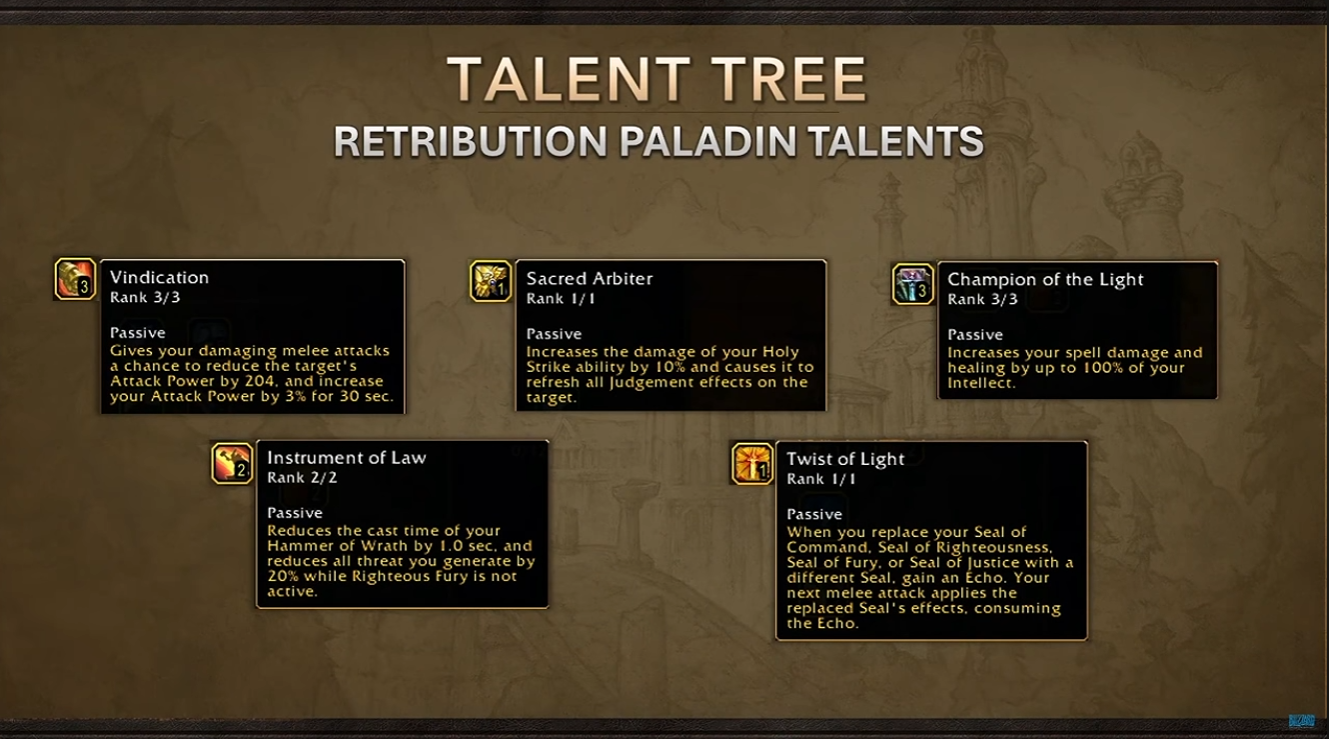
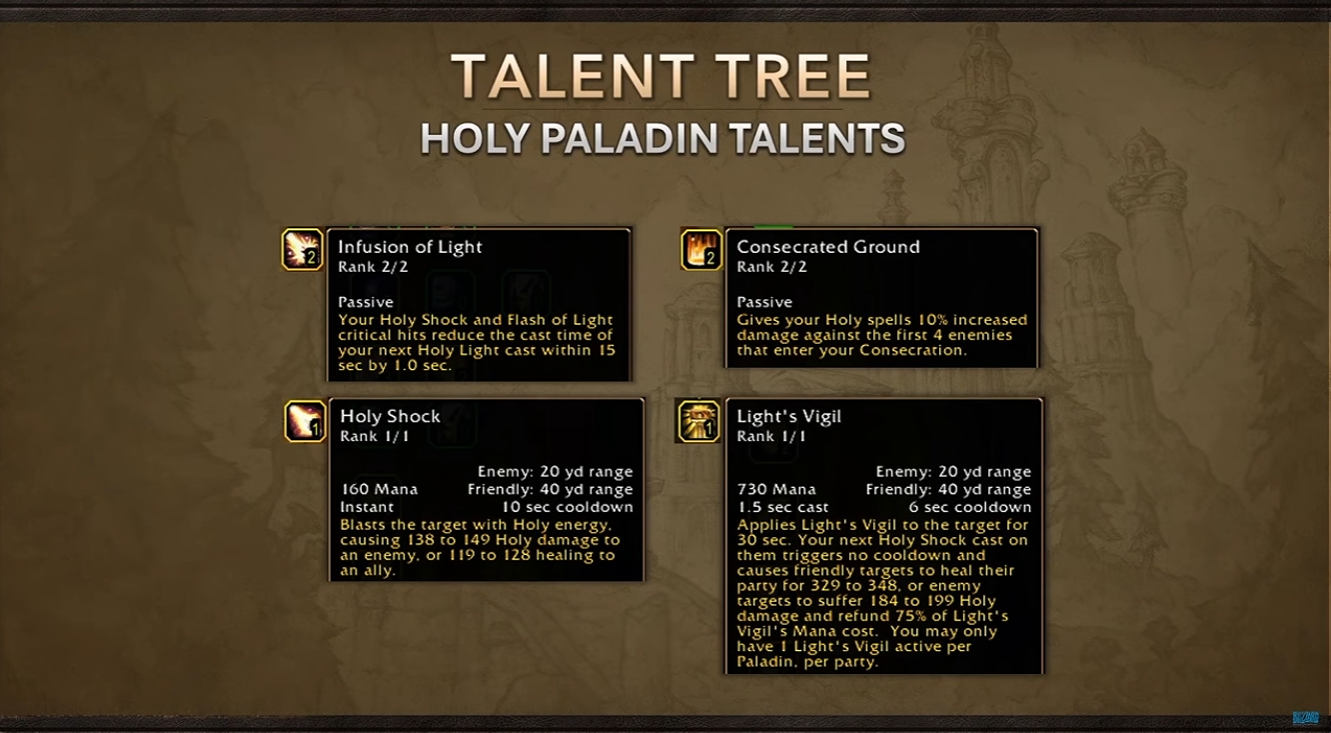
Image inventory: This hub currently shows two authentic in-game talent-tree previews: Holy Paladin and Retribution Paladin. They are beta snapshots, not build recommendations. The checklist below names every class tree so the remaining image gaps are visible. For now, missing previews are labeled as not yet added rather than filled with unrelated or generic art.
| Class | Talent-tree images planned | Current page status |
|---|---|---|
| Warrior | Arms, Fury, Protection | 0 of 3 previews |
| Paladin | Holy, Protection, Retribution | Holy and Retribution previews published; Protection missing |
| Hunter | Beast Mastery, Marksmanship, Survival | 0 of 3 previews |
| Rogue | Assassination, Combat, Subtlety | 0 of 3 previews |
| Priest | Discipline, Holy, Shadow | 0 of 3 previews |
| Shaman | Elemental, Enhancement, Restoration | 0 of 3 previews |
| Mage | Arcane, Fire, Frost | 0 of 3 previews |
| Warlock | Affliction, Demonology, Destruction | 0 of 3 previews |
| Druid | Balance, Feral Combat, Restoration | 0 of 3 previews |
When adding a preview, identify the class tree and beta build in its caption, use useful alt text, and verify the image matches the current in-game tree. Existing class art and calculators are linked separately; neither substitutes for a tree screenshot.
A practical method for planning a WoW Forever talent build
- Choose a job and situation. Decide whether you want a solo leveling route, dungeon tank/healer/damage setup, raid role, or PvP utility. One tree may serve more than one job, but the priorities are not always the same.
- Set the level and point budget. Check how many class talent points you have now and how many the planned build expects. Treat the 11/16/21/31 thresholds as points in a specific tree, not level requirements.
- Inspect each rank. Read the current effect, rank scaling, prerequisite arrows, and whether the ability is baseline. Do not assume the old Classic rank text survives.
- Look at the whole route. Account for prerequisite ranks and milestone choices rather than judging a deep talent in isolation. The points required to reach it are part of its cost.
- Compare the build with your group. A utility, threat, control, or buff contribution may matter more to a party than an isolated damage number.
- Keep class and Legacy points distinct. A class tree uses character talent points. Legacy Points come from account-wide challenges and are spent per character in Legacy perk trees. A Legacy perk does not change the 16-point class-tree milestone.
- Recheck after patches. Record the client build or patch when saving a build link. Revisit your notes after changes to talents, abilities, or prerequisite paths.
What is confirmed and what still needs checking
| Confirmed in Blizzard’s published material | Check in the current client or later updates |
|---|---|
| Familiar class-tree format and row count; 11/16/21/31 one-point milestones; selected talent revisions and baseline buffs; 27 class trees intended as meaningful group choices; 65 Legacy Challenges; six Legacy Challenge categories; three Legacy perk trees; 16 spendable Legacy Points per character at launch. | Final rank values, talent wording, exact prerequisites and point costs for individual Legacy perks, all recommended builds, final tuning, post-launch additions, and any feature changed during beta. |
WoW Forever talents FAQ
Is a Legacy talent tree the same as a class talent tree?
No. A class has three combat-oriented talent trees. The Legacy System has separate Professions, Adventure, and Resourcefulness perk trees funded by account-wide Legacy Challenges.
What does the 16-point talent milestone mean?
It is a one-point choice that becomes available after spending 16 points in one class talent tree. It is not automatically unlocked at character level 16.
How many Legacy Points can I spend?
At launch, each character can spend up to 16 Legacy Points total. Points are shared across the account, and each character can spend them differently. Blizzard says one character can earn enough challenge points to reach the cap.
Do I have to make alts to get Legacy Points?
No. Class challenges encourage trying other classes, but Blizzard says a single character can earn up to 29 points from the announced challenges, above the 16-point per-character spending cap.
Are old Classic builds correct for Forever?
Use them as references for the old tree layout or the purpose of a familiar talent. Forever revises some talents and makes some buffs baseline, so verify exact names, ranks, effects, and requirements against the current client.
Can I use a calculator for every class?
Community Forever calculators now cover the nine classes, but they can trail beta updates. Open the linked calculator, check its source/build notes, and compare important details with current in-game tooltips.
Sources and update notes
- Blizzard: Get to Know the World of Warcraft: Forever Legacy System — challenge counts, access, point earning and spending, perk names, rewards, and Hardcore rules (September 23, 2026).
- Blizzard: World of Warcraft: Forever Deep Dive Panel Recap — class talent-tree structure, 16-point class milestone, baseline buffs, and class talent direction.
- Azeroth Plus: WoW Forever adds a fourth milestone talent at 16 points — our milestone announcement coverage.
- Talents Forever calculator and source notes — community-maintained beta calculator.
- Wowhead Forever talent calculator — additional community calculator.
Last checked September 23, 2026. We separate Blizzard-confirmed rules from calculator data and beta observations. Details can change as testing continues; use the live game and current official announcements for final decisions.